Kühlung
mit flüssigem Stickstoff
Cooling with liquid nitrogen
Immer schön
cool bleiben!
Always cool!
Flüssigstickstoff ist eine verflucht kalte Angelegenheit: Gerade mal
-196 °C oder 77 K beträgt die Siedetemperatur. Über diesen Punkt hinaus läßt
sich die Flüssigkeit bei Normaldruck nicht erwärmen. Die Temperatur bleibt
solange konstant, bis das letzte Quentchen Stickstoff verdampft ist. Zuhause
beim Kochen mit Wasser ist dies nicht anders: Die Temperatur des kochenden
Wassers bleibt konstant, vollkommen unabhängig davon, wie sehr die Kochplatte
aufgedreht wird.
Flüssiger Stickstoff wird in der Chemie und Physik oft zu Kühlzwecken eingesetzt.
Er ist in sogenannten Dewar-Gefäßen (doppelwandige, evakuierte, innen
verspiegelte Glasbehälter; im Prinzip eine Thermoskanne) tagelang lagerbar. Die
Flüssigkeit ist ungiftig, ein kurzzeitiger Kontakt verursacht keine
Verbrennungen/Unterkühlungen, da sich auf der Haut sofort ein Dampfpolster
bildet (sog. "Leidenfrost'sches Phänomen"). Erst längerer Kontakt
führt zu derart starker Abkühlung, daß beispielsweise Blumen wie Glas
splittern.
Liquid nitrogen
is a damn cold thing: the boiling point is -196 °C (-321 °F) or 77 K. Under
normal atmospheric pressure the temperature of the liquid cannot be rised over
this point until the last bit of nitrogen has evaporated. It's exactly the same
with boiling water in your kitchen at home: the temperature remains constant no
matter how much you turn up the heat.
It is common
practice in chemistry and physics to use liquid nitrogen for cooling purposes.
It can be stored for days in so-called Dewar vessels (double-walled, evacuated
and mirror coated glass vessels; basically a thermos bottle). The liquid is
non-toxic, a short skin contact does not cause any burns since a vapour cushion
is forming immediately (known as "Leidenfrost phenomenon"). Longer
contact causes strong cooling and makes e.g. flowers shatter like glass.
|
|
|


Motorkühlung
Engine cooling
Es läßt sich ausführlich begründen, weshalb der Wirkungsgrad eines
Verbrennungsmotors oder allgemeiner einer Wärmekraftmaschine steigt, je besser
die Kühlung ist. Vor diesem Hintergrund haben wir uns angestrengt, ein
Thermogefäß für einen X-Cell Fury Extreme
90 aus Styropor und GfK herzustellen, das zur Kühlung des Motors mit
flüssigem Stickstoff befüllt werden kann. Obwohl das ganze theoretisch
funktionieren würde, sind in der Praxis große Probleme durch den hohen
Temperaturgradienten von +135 °C am Zylinderkopf zu –196 °C im
Thermogefäß zu erwarten. Wirklich gelaufen ist der Motor mit dieser Kühlung
bislang nicht. Mit anderen Worten: Die ganze Aktion war ein gelungener Aprilscherz
für die April-Ausgabe von ROTOR!
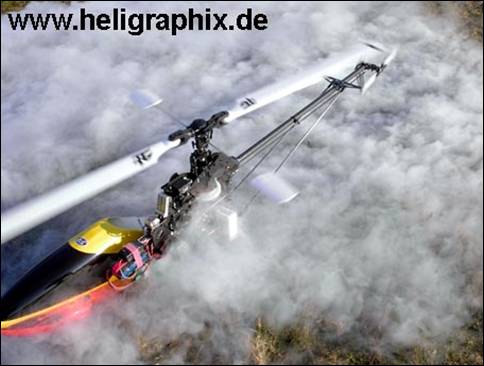
Die Fotos sind nichtsdestoweniger schön anzusehen. Der viele Nebel
entsteht übrigens durch kondensierende Luftfeuchtigkeit. Und wie schon gesagt: Mehr Details in
ROTOR 04/2003!
It can be shown
in detail why the efficiency of an internal combustion engine (or any
thermodynamic machine, to be more exact) goes up when the cooling gets better.
That's why we tried and built kind of a thermos vessel for an X-Cell Fury
Extreme 90. It was made of styrofoam (insulation) and coated with glass
fibre (stabilitiy) and could be filled with about 250 mL of liquid nitrogen to
cool the engine. Even though this works fine in theory, quite some problems
will arise from the large temperature gradient of about +135 °C (275 °F) at the
cylinder head and –196 °C (-321 °F) in the thermos vessel. The engine
hasn't actually run with this kind of cooling so far. In other words: the whole
action was an April-fool joke for the April issue of ROTOR!
Nevertheless, the
pictures are nice to look at. The smoke is caused by condensing air humidity. For
more details, have a look at ROTOR 04/2003, it's certainly worth the
few Euros!
|
|
|
|
|
|


Wer ist
Heinrich Degner?
Who
is Heinrich Degner?
Wer ist "Heinrich Degner", der diesen Artikel
geschrieben haben soll? Ganz einfach ein Kunstname aus: Heinrich Wagner, Rainer Deragisch
und Tobias Wagner. Klang doch gut?! J Besonderer Dank gebührt Matthias Weber, der
beim Laminieren des Thermogefäßes tatkräftig mitgewirkt hat.
Who is this
"Heinrich Degner" guy that wrote the article? It's a
fictitious name made up of three others:
Heinrich Wagner, Rainer Deragisch
and Tobias Wagner. Sounds realistic,
doesn't it?! J Special thanks
goes to Matthias Weber who helped with laminating the thermos vessel.

