Factor
Blades FB 68 und FB 68 EX II
Eine neue
Idee am Horizont
A new idea on the horizon
 Rotorblätter gibt es
mittlerweile wie Sand am mehr, und angesichts der angebotenen Vielfalt wird es
schwierig, den Überblick zu behalten. Die slowakische Firma Ties Principe
aus Soblahov, die schon seit langem Segelflugmodelle für die Kategorien F3B,
F3F und F3J produziert, arbeitet nach eigener Aussage bereits seit 1990 an
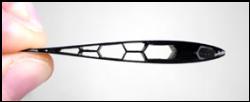
einem neuartigen, heute patentierten Blattaufbau. Anders als bei herkömmlichen
Blättern wird kein Kern aus beispielsweise Styrodur verwendet, sondern das
Blatt wabenartig von Kohlefaserstegen durchzogen. Der Torsionssteifheit soll
dies sehr zugute kommen, während das Blatt gleichzeitig zur Aufnahme von
Schlagbewegungen relativ biegeweich bleibt.
Rotorblätter gibt es
mittlerweile wie Sand am mehr, und angesichts der angebotenen Vielfalt wird es
schwierig, den Überblick zu behalten. Die slowakische Firma Ties Principe
aus Soblahov, die schon seit langem Segelflugmodelle für die Kategorien F3B,
F3F und F3J produziert, arbeitet nach eigener Aussage bereits seit 1990 an
einem neuartigen, heute patentierten Blattaufbau. Anders als bei herkömmlichen
Blättern wird kein Kern aus beispielsweise Styrodur verwendet, sondern das
Blatt wabenartig von Kohlefaserstegen durchzogen. Der Torsionssteifheit soll
dies sehr zugute kommen, während das Blatt gleichzeitig zur Aufnahme von
Schlagbewegungen relativ biegeweich bleibt.
There's no end of
main blades available today, and it is hard to keep track. Ties Principe
is a Slovak company and has been known as a manufacturer of F3B, F3F and F3J
gliders. Back in 1990, at least that's what we were told, they started
designing a new generation of rotor blades that is patented today. The core is
no longer made of e.g. styrofoam but the whole blade contains a carbon
honeycomb structure. The manufacturer says this accounts for a high torsional
rigidity while the bending resistance still enables the blade to absorb rocking
blade movements.
Flugeigenschaften
Flight characteristics
Zunächst erhielten wir ein Blattpaar mit der Bezeichnung 'FB 68' zum
3D-Testfliegen. Die Schwebeflugruhe war gut, bei großen zyklischen Ausschlägen
war das Blatt auch recht wendig, allerdings wurde dem Motor auch merklich
Leistung abverlangt. Blattschlagen war wenig zu hören (das Blatt ist eines der
wenigen, das einen leichten Nachlauf aufweist), die Autorotationseigenschaften
waren überzeugend. Letztendlich haben wir den Eindruck gewonnen, daß das Blatt
für den Allroundpiloten bis sportlichen Flieger durchaus geeignet, für den
3D-Piloten vielleicht ein wenig zu träge und leistungszehrend ist (mehr Details
in ROTOR 04/2003 sowie in der Tabelle unten).
Nach Rücksprache mit Ties Principe erhielten wir einen zweiten
Testsatz mit der Bezeichnung 'FB 68 EX II'. Wofür das 'II' steht, konnten wir
nicht in Erfahrung bringen; zu diesem Zeitpunkt waren die 'EX'-Blätter
offiziell noch nicht erhältlich, weshalb eine Bezeichnung als Version 2 wenig
sinnvoll erscheint. 'EX' bedeutet "extrem steif" – die
Schlaghärte und damit Energiehaltung der Blätter sollten dadurch besser sein.
Kurz gesagt: Das Steuerverhalten mit diesen Blättern war direkt, aber nie
unangenehm, der Heli verhielt sich agil bei guter Leistungsumsetzung, auch
Autorotationen waren problemlos zu bewerkstelligen. Zumindest beim Testsatz kam
es bei hohen Endgeschwindigkeiten zu merklichen Strömungsabrissen. Alles in
allem waren wir von der 'EX II'-Version sehr angetan (mehr Details in ROTOR
04/2003 sowie in der Tabelle unten).
At first we
received a pair of 'FB 68' for 3D test flying. Even though the hovering
stability was good and the blade was agile when pushed a little, we were not so
happy with the power consumption. There was not much blade flutter (this blade
is one of the very rare examples with lag!), the autorotation qualities were convincing.
After all, we felt that the blade was good for the all-round and sports flyer,
but maybe a bit too slow and energy consuming for the 3D flyer (see ROTOR
04/2003 and the table below for details).
After reporting
this to Ties Principe we received another pair called 'FB 68 EX II'.
We've been wondering about the 'II' which obviously means we received a second
version of the blades – even though they were not generally available at
that time. Anyway, the 'EX' stands for "extra stiff" which means the
bending resistance is higher and the blades should consume less energy during
demanding flight. To cut a long story short, the blades felt direct but were
not intimidating in any mode of flight, they made the heli agile, the energy
conversion was good as was the autorotation performance. In high speed flight
there was a noticeable tendency to stall. All in all, we really were quite
happy with this 'EX II' version (see ROTOR 04/2003 and the table below for
details).
|
|
|
|
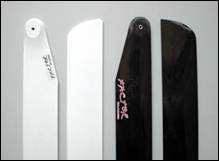
'FB 68' neben
'FB 68 EX II'. Die Blätter sind mit |
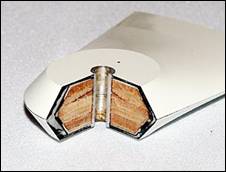
Schnitt durch
die Blattwurzel |
Preis &
Bezug
Price & contact
Der Produktionsaufwand ist im Hinblick auf die Wabenstruktur recht
hoch, überhaupt ist die Verarbeitung der Blätter mustergültig. Das hat
natürlich seinen Preis. Fraglich bleibt allerdings, ob der neuartige Aufbau
gegenüber der konventionellen Fertigung wirkliche Vorteile bringt. Entscheiden
müssen Sie letztendlich selbst, einen Versuch sind die Blätter allemal wert
(Bezug über sales@factorblades.com).
Obviously it
takes a lot of effort to produce the honeycomb structure. Also, the finish of
the blades is nothing less than excellent. That doesn't make the product
exactly cheap. We'd like to make the point that even though the blades perform
well the question remains whether there are significant advantages over a conventionally
produced blade. Anyway, you'll have to decided for yourself; the blades are
well worth a try (mail to sales@factorblades.com).
|
|
Factor |
Factor |
|
|
|
FB 68 |
FB 68 EX II |
|
|
Physikalische Daten |
|
|
Physical Data |
|
Material |
CfK
(Waben) |
CfK
(Waben) |
material |
|
Schlaghärte |
oo- |
ooo |
bending
resistance |
|
Torsionssteifheit |
oo |
oo+ |
torsional rigidity |
|
Verarbeitung |
ooo- |
ooo |
finish |
|
Profil & Profildicke |
vollsymm.,
7 mm |
vollsymm.,
7 mm |
profile |
|
Profiltiefe |
59,5 mm |
59,5 mm |
chord |
|
Schwerpunkt ab Mitte Bohrung |
364 mm |
347 mm |
lenghtwise CG |
|
Schwerpunkt hinter Nasenleiste |
(17,0 ± 0,5) mm |
19 mm |
chordwise CG |
|
Bohrung (Mitte) hinter Nasenleiste |
18,5 mm |
18,5 mm |
bolt hole position |
|
Vorlauf |
-2,5 mm |
1 mm |
lead/lag |
|
Gewicht (pro Blatt, gemessen) |
(196,3 ± 0,3) g |
(172,5 ± 0,0 ) g |
weight |
|
Länge ab Mitte
Bohrung (gemessen) |
680 mm |
680 mm |
length (measured
from bolt hole) |
|
Blattanschluß & Bohrung |
14 mm / 4
mm |
14 mm / 4 mm |
blade joint
& bolt hole |
|
Randbogenform |
rund |
rund |
form of blade
end |
|
|
|
|
|
|
|
|
|
|
|
Flugverhalten |
|
|
Flight
Characteristics |
|
Schwebeflugruhe |
ooo- |
oo |
hovering
stability |
|
Direktheit / Aggressivität
Pitch |
o+ |
oo- |
directness/aggressiveness
pitch |
|
Direkth. / Aggr. zykl. Eingaben |
o |
oo |
directness/aggr.
cyclic inputs |
|
Direkth. / Aggr. zykl. Endausschl. |
oo |
ooo- |
directness/aggr.
max. cyclic inputs |
|
Zyklisches "Expo-Verhalten" |
oo |
oo+ |
cyclic
"exponential feeling" |
|
Endgeschwindigkeit |
oo |
oo |
terminal speed |
|
Blattschlagen |
ooo |
ooo |
blade flutter |
|
Auffällige Blattgeräusche |
--- |
--- |
conspicuous blade
noise |
|
|
|
|
|
|
|
|
|
|
|
Leistungsumsetzung |
|
|
Power Conversion |
|
Pitch (Steigvermögen) |
oo- |
oo+ |
pitch (climb
rate) |
|
Zyklische Funktionen |
oo- |
ooo- |
cyclic functions |
|
Autorotation |
ooo- |
oo+ |
autorotation |
|
|
|
|
|
|
Preis |
|
|
Price |
|
Unverb. Preis |
EUR 90,- |
EUR 105,- |
SRP |
